
Scheduling Software Designed with Higher Education in Mind
Somewhere on every campus, a scheduler has thought, ‘It would be so much easier if the system could just do this.’
One interesting part of building products is that they’re iterative. They start small. Ours started as an algorithm: a complex equation that matches classes to rooms. Next came a program for making academic schedule changes, then analytics for reporting on scheduling data. Event scheduling followed, so registrars and event managers could book the same rooms in the same system. Today it’s a fully SaaS application that lets the campus community participate in ways they never could before, with SIS imports and manual updates reflected live.
A narrative that we’ll never try to convince you of is that we’ve iterated without the input of higher education. And why would we want to? When schedulers tell us, ‘It would be so much easier if the system could just do this,’ we listen. We ask questions. We write it down. We have meetings about it. We talk about how it might work and how many schools it could help. We’ve been listening to the needs of higher education since the very beginning.
What Schools Wanted Was a Solution for Class Placement
The Problem: A university with thousands of courses, rooms, and time slots must figure out which rooms to place courses in and how to do it.
The Cost: Even if a school can copy section assignments year to year, there are often many manual placements and A LOT of lost time.
What it became: The powerful algorithm behind the Schedule25 Optimizer. (Created way back in 1977. Really!) Today, the Optimizer has many more configuration options, and Optimizer Grids allow schedulers to finely tune the results and collaborate.
What Schools Wanted Was One Place to Schedule Everything
The Problem: Classes and events use the same rooms, but they are often scheduled by different departments in different systems. If those teams share rooms and resources, each team has to work around what the other is doing.
The Cost: At minimum, regular checks of the other system to make sure conflicts are avoided. At worst, accidental double-bookings and duplicated work from entering the same information into two systems.
What it became: 25Live, one unified system for both academic and event scheduling. Everyone has access to the same information, and when one team makes an update, it is reflected immediately. Same rooms. Same reservations. No double-bookings. (Phew!)
“All the problems we used to have with double bookings, moving classes – having to check and update multiple calendars whenever there was a schedule change – are gone now.” —Marylou Holly, George Mason University.
What Schools Wanted Was Faster SIS Synchronization
The Problem: Scheduling systems need to pull section data from the SIS, but if those two systems don’t stay current with one another, someone must reconcile them. Unfortunately, many tools offer once-a-day imports or slow batch loading.
The Cost: The longer the gap between updates, the more changes pile up, and the more chances for conflicts.
What it became: LYNX, a two-way integration between an SIS and scheduling system. Schedulers import SIS data into 25Live, collaborate on updates, and send the results back to the SIS. It syncs every minute. No hours-long batch loading or once a day updates.
“I’m used to sitting and importing all the 1000-1500 spring courses over about three hours. With LYNX, I was done in less than five minutes. I was completely floored. You just select a semester, push it through, and poof—it’s done! It’s truly night and day.”
—Gina DeBernardo, Providence College
What Schools Wanted Were Real Scheduling Metrics
The Problem: Scheduling systems show where a class or event is going, but not how well space is being used. Data about utilization and campus activity are often necessary to business processes, and if the right report isn’t available in the scheduling system, someone must build it.
The Cost: Exporting raw data from several systems, in several formats. Trying to put the pieces together and making guesses when there are gaps.
What it became: X25 Analytics, which turns scheduling data into real numbers on room utilization, campus activity, and more. It pulls data directly from 25Live into the graphical web interface and offers over 20 standard reports.
At Montclair State, X25 Analytics helps staff see what a schedule will look like before it goes live: “If they give me an estimated headcount—how many locations, how many seats on average—I can show through predictive modeling what a class schedule push through Banner would look like, where the foot traffic would be, and what the utilization would be.”—Zachary Bonelli, Montclair State
So, Is Your Vendor Listening?
The best scheduling tools got better one conversation at a time. To see whether a vendor is still having those conversations with the people who use it, and, more importantly, whether the product is being shaped by those conversations, ask these questions:
- Does it cover academic, event, and resource scheduling, or only one?
- Can it assign sections in bulk and apply our own rules automatically?
- How often does it sync with our SIS, and in which directions?
- Can we model scenarios before a building closes or enrollment shifts?
- Can we see utilization without exporting to spreadsheets?
- Do requesters self-serve, or does staff handle every request?
- Is the platform built specifically for higher education?
How We Compare to Other Scheduling Solutions
Here is how CollegeNET’s 25Live suite lines up against four other scheduling tools (CourseDog, EMS, Mazevo and Ad Astra) on the features schedulers ask about.
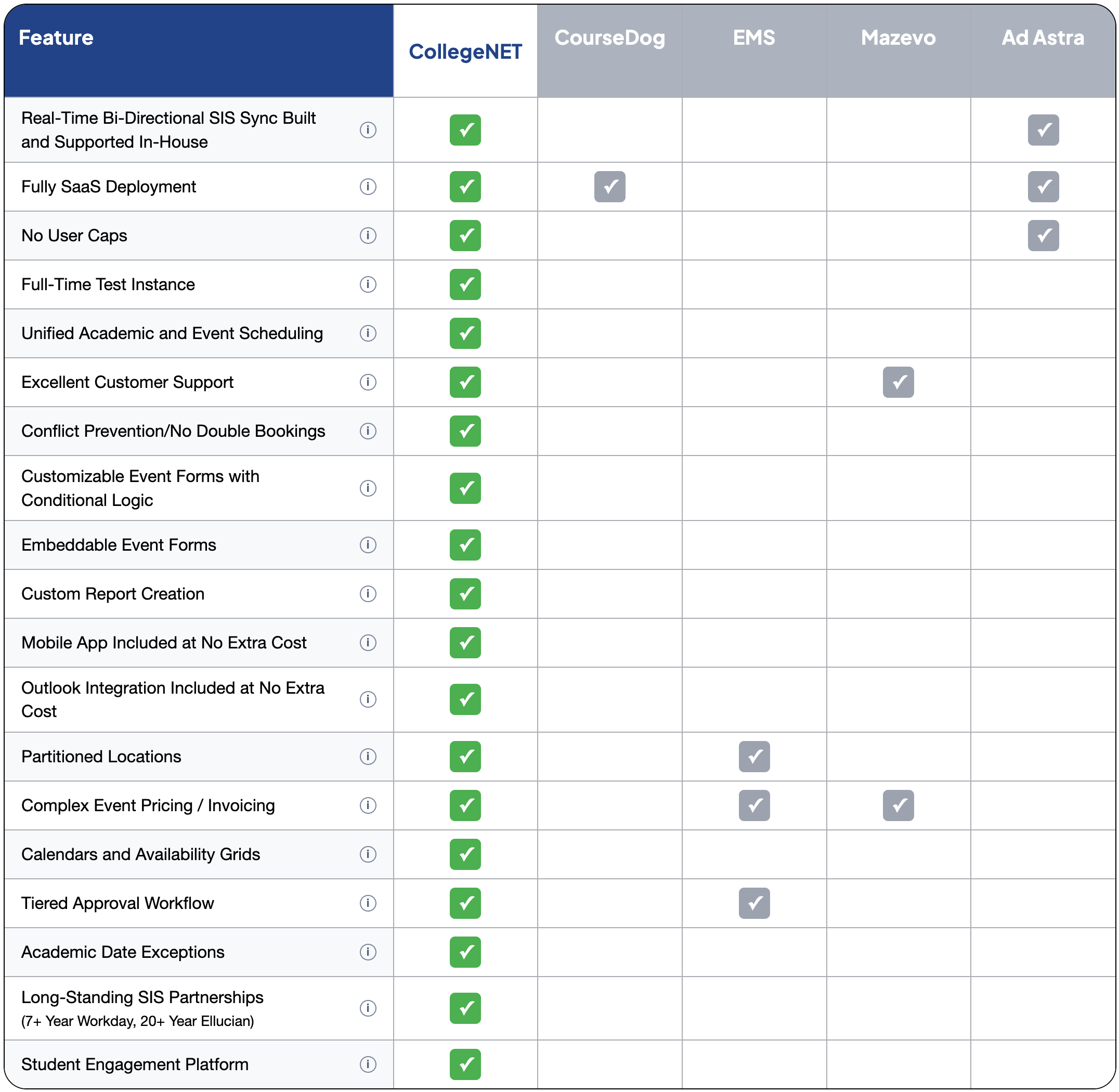
Comparison based on publicly available information as of October 2026.
25Live Offers…
- One unified system, built for higher education. Registrars and event managers book the same rooms from the same reservations. Customizable and embeddable event forms with conditional logic, complex pricing and invoicing, and availability grids let requesters self-serve, and tiered approvals and partitioned locations let each department run its own rules.
- Integration that keeps up. Two-way SIS sync is built and supported in-house and backed by long-standing partnerships (7+ years with Workday, 20+ years with Ellucian).
- Placement on your rules. The Schedule25 Optimizer places sections in bulk using your department preferences, space features, capacity needs, and utilization goals.
- Utilization and planning in one place. X25 Analytics shows room utilization and campus activity in a graphical web interface and supports master planning so you can test changes to your space before you commit to them.
- Fewer limits. 25Live has no user caps, a full-time test instance, and a mobile app and Outlook integration at no extra cost.
“One thing I can definitely say I commend about CollegeNET is when users bring up an issue, and you say, ‘We’ll put in a ticket for that,’…we actually see it happen…Then, the next thing you know, it’s on the board as a new feature, or you get the email update.”—Jaime Dennison, Norfolk State
Bring Us Your List
Every feature above started as someone’s wish list, and that’s still how we build. Bring your own “It would be so much easier if the system could just do this” list to a live demo of the 25Live suite. We’ll show you what’s possible today, and we’ll write down the rest.
