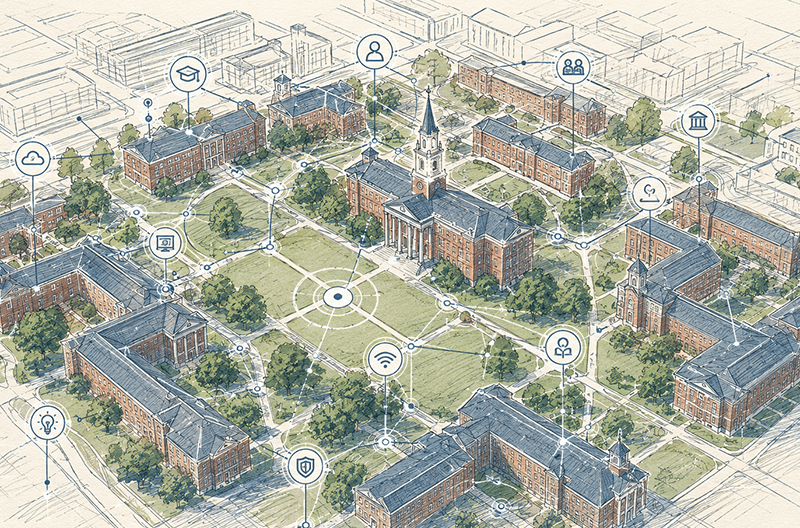
On many campuses, the scheduling picture looks something like this:
- A scheduling system that’s been in place for over a decade, slow to load, and siloed from everything else.
- A Facilities calendar that doesn’t sync with the first.
- That shared inbox that no one officially owns, but everyone uses.
- In each system, there’s an approved reservation request, each from a different organization, each conflicting with the others.
All records are accurate from their own angle, but none represent the truth.
Most scheduling platform vendors would arrive at this moment with cheerful advice: throw it all out. Start fresh. With a shiny new foundation, the old systems, email chains, and workarounds won’t matter anymore. A scheduler might smile at the demo, nod at the implementation kickoff, and spend the next eighteen months rebuilding the same workaround infrastructure, because the new system didn’t know a thing about the institutional knowledge the old one had absorbed.
When implementing 25Live, we don’t ask you to start over. We ask you to tell us what your system is like so that we can adapt to your needs and save you the time of rebuilding those workarounds. We want to help you avoid the cost of a disconnected scheduling infrastructure. So, before you evaluate any platform, ask: What does it protect, and what does it retire? Are they willing to work with our systems?
Built for Higher Education. Not Retrofitted for It.
Most scheduling platforms lead with disruption: replace your workflows, abandon your systems, start clean. What they don't account for is the institutional logic embedded in those processes, and the cost of losing it. Institutions that pursue wholesale replacement rather than improvement often find themselves rebuilding within a new system to address deficiencies within months of go-live.
In some cases, legacy workarounds and manual processes are genuine friction. But more often, they reflect hard-won institutional decisions that no vendor has taken the time to understand. Replacing one system with another (without accounting for the logic those systems were built around) breaks the parts that were quietly working and produces the same fragmentation in a new environment. The institution hasn't modernized. It's transferred its problems to a different platform.
The smarter design question isn't what should we replace? It is: what should we preserve, and what should we finally stop tolerating?
Your System Should Preserve What’s Working For You
A scheduling platform like 25Live is a system that works with your processes. The solution isn’t to ask your institution to start over, but to do something far harder: take the time to learn how your campus already works.
Your scheduling infrastructure reflects decades of institutional decisions. It was built brick by brick, shaped by every brainstorming session, compromise, abandoned process, and rebuild along the way. So why hand a wrecking ball to a vendor that’s never seen your blueprints? This is where 25Live differentiates itself. It is developed and supported by those who recognize the difference between institutional logic that deserves respect and institutional inertia that deserves retirement.
25Live deliberately preserves:
• The approval hierarchies your campus already trusts. Department heads still approve their spaces. Athletics still owns athletics facilities. The provost still sees the scheduling decisions that intersect with academic policy. 25Live encodes the routing your campus has already developed. It doesn't propose an alternative.
• Role-based ownership that mirrors your org chart. Student Activities keeps visibility into extracurricular bookings. Facilities retain operational autonomy. The events office doesn't get demoted to a ticket queue. The system reflects the organization rather than arguing with it.
• Your campus vocabulary. If your institution has called a venue the Lyceum since 1962, 25Live calls it the Lyceum. Pricing categories, event types, resource names. 25Live will configure it all to your institution's language, not vendor defaults.
• A published calendar that your community will really use. Faculty, students, and the public continue to see a familiar calendar. The first-year student looking for the date of the next home game doesn't need to learn a new system because your scheduling infrastructure has changed.
• Institutional priorities, codified. Academic instruction takes precedence over events. Mission-critical programming takes precedence over optional ones. The hierarchy your campus already lives by is formalized rather than left to the memory of a few key players.
The result, for institutions that have made the switch to 25Live, isn't just fewer conflicts; it's time back. Beverly Roth at the University of Findlay described it directly after implementation: "All data updates are automatic and fast. Information is current within minutes, so we don't have to think about administrative fixes anymore." That's not a feature. That's staff capacity returned to mission-critical work.
The Problems Your System Should Catch
Some parts of your current system exist for good reasons, but others are a consequence of tools that were never built for the complexity of campus scheduling. A system that can't catch a double-booking forces someone to catch it manually. A calendar that doesn't sync with Facilities forces someone to cross-reference. The parts of campus scheduling life that 25Live does not preserve are the parts that were only necessary because the old tools couldn't handle them.
What 25Live eliminates:
• Double-bookings. 25Live has real-time conflict detection that catches collisions before two department heads, one jazz ensemble, and a campus tour all arrive in the same room at the same time. It is a built-in traffic controller that, at the start of the request process, quietly guides users to available, similar spaces.
• Fragmented systems that don't talk to each other. One authoritative source of truth replaces the patchwork of disconnected platforms. Facilities, academic affairs, and student activities see the same booking when they view the same space, whether they check the calendar on the university home page, on a tablet outside the room, or via a request form in the app. No more cross-referencing. No more conflicting records.
• Email-driven approvals. Approval routing moves inside the system, with a complete trail. Nothing gets lost in the space between. Every step of the approval is visible and timestamped. The question "where did this request go?" has an answer that doesn't require thirty minutes of inbox archaeology.
• Manual reconciliation. Resources, setup requirements, AV equipment, and catering coordination are all attached to the booking in 25Live rather than tracked on a separate sheet by someone who is also managing seven other things.
• Communal knowledge as infrastructure. The institutional rules that used to live in one coordinator's head get encoded in the system. When that coordinator retires, the rules don't retire with her. The new coordinator inherits a system that already knows how the campus works.
• Invisible space utilization. Rooms that were technically booked but never used. Departments holding inventory "just in case." Buildings running at half capacity while another building runs hot. All of it becomes visible and actionable.
25Live helps you create real improvements rather than haphazard replacements. And the distinction leads to real outcomes at real institutions. The University of Tennessee, Knoxville, reported a near 80% reduction in administrative time after implementing 25Live. Doane University cut the time required to schedule events in half and saw user satisfaction climb. Proof that 25Live is designed to work with institutional reality rather than against it.
Most of the Work Is Knowing Which Is Which
25Live wasn't designed by someone deciding from a distance which campus traditions deserved respect. It is continuously iterated, alongside real registrars, event coordinators, and facilities directors who lived the consequences of the wrong call. 25Live adapts to modern issues and needs in higher education. The discipline this represents rests on a simple idea: preserve the logic; replace the limitations. Keep the institutional reasoning. Retire the workarounds that exist only because the old tools couldn't carry the reasoning themselves. Keep what works for you and build on it.
Some processes deserve to be retired. But the decision about which is which should be made by people who understand the institution, not assumed away by a platform that arrived with a demo and a playbook.
What Happens When Both Sides of That Equation Hold
When preservation and replacement are calibrated correctly, the campus experience looks different.
• Staff adopt the system rather than work around it. The system already reflects how they operate, so the workarounds that accumulated around the old platform's limitations don't follow them into the new one.
• Institutional leaders get visibility they didn't have before. The same scheduling rules and hierarchies that have been running invisibly for years now show up as data. Utilization patterns and demand forecasts answer questions the university couldn't ask before, such as: Which departments are scheduling more than their fair share of peak-use times? Or, which university resources have been gathering dust, unused from term to term?
• The campus becomes capable of things it couldn't do before. Modeling a building closure. Absorbing 400 course sections into a reduced inventory. Running a multi-year capital planning scenario and knowing the numbers are reliable.
These capabilities are the natural consequence of having accurate, unified, real-time data about how your campus actually uses space, powered by software developed by people who have spent decades working in higher education.
These capabilities aren't extravagant. They were the ones Carleton College had been trying to get for years, and are now finally available without requiring manual effort to bridge the gap. Noel Ponder, Manager of Conferences and Event Services at Carleton, put it simply: "25Live offered us all the capabilities we weren't getting from our old system, plus far superior customer service."
This is what purpose-built means in practice: a platform designed specifically for higher education and for real campus situations.
Useful Software Knows What to Change and What Not to Change
Modernization is not demolition. It is discernment. Modernization isn't about what your campus is willing to abandon; it's about what your campus has been doing right all along and what it deserves to finally stop tolerating. 25Live is built to tell the difference.
The question is whether your system is doing its job or if you're asking it to compensate for a system not built with your use cases in mind. You need a system built to fit how your campus actually works, like 25Live.
Visit collegenet.com/scheduling to learn more or schedule a conversation with the 25Live team.